How Dogs Smell the World, and Why Sniffing Walks Matter
People walk dogs the way they walk themselves: forward, at a steady pace, towards a destination. For the animal on the other end of the lead, that describes a fairly poor outing. Dogs do not experience a walk mainly through their eyes.
Two noses in one
Air entering a dog's nose splits. Part goes to the lungs; part is routed to a dedicated olfactory chamber, where a folded membrane many times the surface area of ours traps molecules. Exhaled air leaves through side slits, so breathing out does not blow the scent away — a dog can sample continuously, and a rapid series of short sniffs is the canine equivalent of leaning in to read small print.
Smell has a direction and a clock
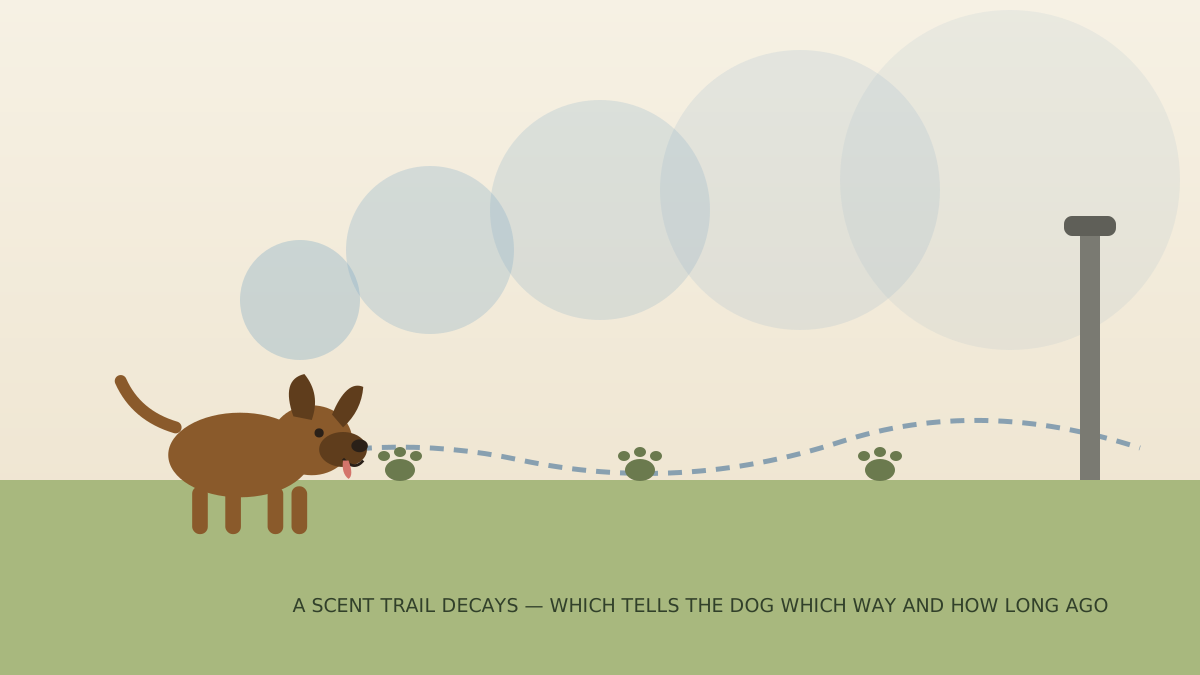
Because the nostrils sample independently, a dog can tell which side a smell is stronger on, which is why tracking looks like weaving. More striking is the time dimension: a scent trail decays, so the difference in intensity between one footstep and the next tells the dog which way the walker went, and roughly how long ago. What we experience as a smudge of smell, a dog reads as a sequence.
The lamp post is a message board
Marking is not just territory. Urine carries information about the individual, and a well-used post accumulates layers of it. A dog reading one is doing something closer to scrolling a feed than to answering nature. Rushing that reading is the walking equivalent of dragging someone past a conversation.
Why sniffing calms dogs down
Trainers noticed long before the research caught up that scent work settles dogs. Nose work is mentally demanding, self-directed and rewarding, and a dog that has spent twenty minutes solving smells usually comes home ready to sleep rather than ready to patrol. Owners dealing with over-arousal at home often get more from a slow, boring-looking sniff walk than from a run.
Making a better walk
- Use a longer lead in safe places and let the dog choose the route for part of the outing.
- Stop when the dog stops. Give it the full ten seconds at the post.
- Scatter part of the daily food in grass at home and let the dog hunt it.
- Change the route weekly — new smells matter more than new distance.
None of this requires equipment or expertise. It requires accepting that the walk belongs to the dog.
Running a sniffing walk without losing the walk
The objection to letting a dog sniff is always the same: the walk stops being a walk. That is a problem of structure, not of sniffing. Split the route into two states and tell the dog which one it is in.
Use a longer line — three to five metres, on a harness, never on a collar — and a phrase such as "go sniff" that releases the dog to work. In that state the dog sets the pace and you follow. Then a second phrase, "let's go", brings the lead back to walking length and the dog moves with you. Dogs learn the difference in about a week, because the contrast is obvious and both states are worth having. Fifteen minutes of released sniffing followed by five minutes of structured walking will beat twenty minutes of tension in both directions.
Indoors, the same work costs nothing. Hide ten pieces of food around one room while the dog waits in another, then let it in. Most dogs need three or four repetitions before they search systematically instead of randomly, and a dog that has searched systematically for ten minutes generally goes to sleep afterwards.
Frequently Asked Questions
How much better is a dog's sense of smell than ours?
Estimates vary widely by breed and method, but dogs have vastly more olfactory receptors than people and a far larger share of the brain devoted to processing smell.
Why does my dog stop at every lamp post?
Marked posts are a noticeboard. From a single spot a dog can gather who passed, roughly when, and something about their condition — then leave its own note.
Are sniffing walks better than long walks?
They serve different purposes, but for most companion dogs twenty minutes of free sniffing is more satisfying and more calming than the same time spent marching in a straight line.
How long should a sniffing walk be?
Fifteen to twenty minutes of released sniffing is enough for most adult dogs, and it can replace a share of the physical walk rather than being added on top. Shorter and more frequent beats one long session.
Does letting a dog sniff make it pull more?
Not when the two states are separated. Pulling gets worse when sniffing is allowed only intermittently and unpredictably, because the dog learns to lunge at the chance. A clear release cue and a clear walking cue reduce pulling over a few weeks.
Sources & Further Reading
- Cornell University College of Veterinary Medicine — www.vet.cornell.edu
- The Kennel Club — canine enrichment and activities — www.thekennelclub.org.uk
Last updated: 9 August 2026